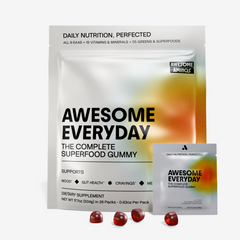
It’s 2pm. You slept okay, you had your coffee, and still you feel flat. Not bad, just a little off, a little short on patience, a little less like yourself than you want to be for the rest of the day. Then you scroll past an ad for mood gummies, bright and cheerful and promising good vibes in a bottle. It’s tempting. But can a gummy actually support your mood, or is it just candy with a nice label?
It’s a reasonable question, and the answer depends almost entirely on what’s inside the gummy.
The short answer: Mood gummies can support everyday mood when they provide nutrients your body actually uses to make its own mood-related brain chemicals. Your brain builds serotonin from the amino acid tryptophan, and dopamine and norepinephrine from phenylalanine and tyrosine. A gummy can’t create a good mood for you, but the right nutrients can support the normal processes your body already uses every day.
In this blog, we’ll explore what’s usually inside mood gummies, how your body makes mood-related brain chemicals, why amino acids matter, why “complete” beats “single ingredient,” the gut-brain connection, what to look for on the label, and where Awesome Everyday™ fits.
What’s Actually Inside Mood Gummies?
“Mood gummies” isn’t a defined category, so two bottles with the same name can contain completely different things. Most fall into a few groups: herbal and adaptogen blends, single nutrients like magnesium or vitamin D, sleep-focused ingredients, and formulas that provide the building blocks the body uses to make its own brain chemicals.
That’s why one person can swear by a mood gummy and another can feel nothing at all. Before asking whether mood gummies work, it helps to ask what a specific gummy is giving your body and how your body would use it.
How Your Body Makes Its Own Mood Chemicals
Your mood isn’t made from nothing. Your brain relies on chemical messengers called neurotransmitters, including serotonin, dopamine, and norepinephrine, to send signals that shape how you feel, focus, and respond to your day. And your body builds those messengers from amino acids that come from your food.
Research summarized in a review on dietary amino acids and the brain explains that the amino acids tryptophan and tyrosine are taken up into the brain and converted into serotonin and catecholamines, a group that includes dopamine and norepinephrine. A separate review in The Journal of Nutrition notes that, unlike most brain chemicals, the production of serotonin and catecholamines is sensitive to how much of these amino acids is available, which means diet can influence it.
In simple terms, your body can only make these messengers from the raw materials it has.
The Mood Building Blocks
|
Nutrient |
Type |
What the body uses it for |
|---|---|---|
|
Tryptophan |
Essential amino acid |
Building block for serotonin and melatonin |
|
Phenylalanine |
Essential amino acid |
Converted into tyrosine, then into dopamine and norepinephrine |
|
Tyrosine |
Made from phenylalanine |
Building block for dopamine and norepinephrine |
|
Vitamin B6, folate, B12 |
Vitamins |
Help the body carry out the steps that turn amino acids into brain chemicals |
Notice what tryptophan and phenylalanine have in common. Both are essential amino acids, which means your body cannot make them on its own. According to MedlinePlus from the National Library of Medicine, essential amino acids must come from food. If they aren’t coming in consistently, your body has less to work with.
Why Complete Beats Single-Ingredient
It might seem like the answer is just to take more tryptophan. But the body doesn’t work in isolation. Amino acids compete with each other to get into the brain through the same transport system.
The same review on dietary amino acids found that raising blood levels of branched-chain amino acids (BCAAs) lowers the uptake of tryptophan and tyrosine into the brain. It’s one reason taking a few amino acids alone, like a BCAA-only supplement, isn’t the same as giving your body the full set.
That’s why balance matters more than any single ingredient. All 9 essential amino acids work together, alongside vitamins and minerals, to support the body’s normal everyday functions involved in mood, focus, energy, and recovery.
The Gut-Brain Connection
Mood isn’t only about the brain. Harvard Health notes that about 95% of your body’s serotonin is produced in your gastrointestinal tract, which is lined with a hundred million nerve cells. The bacteria in your gut also help you absorb nutrients from your food.
That means how well you digest and absorb nutrition plays a real role in how your body uses it. Prebiotic foods that feed beneficial gut bacteria and ingredients that support digestion are part of the everyday mood picture, not separate from it.
So, Do Mood Gummies Actually Work?
It depends on what they’re doing. A gummy that gives your body the nutrients it uses to make its own brain chemicals can support everyday mood as part of a healthy routine. A gummy that relies on vague blends, mostly sugar, or big promises is a different story.
It also helps to keep expectations realistic. No gummy replaces the basics. Sleep, balanced meals, hydration, movement, daylight, and time with people you care about all shape how you feel. Nutrition supports those habits. It doesn’t replace them. And if low mood lasts or is affecting your daily life, talk with a healthcare provider.
What to Look for in a Mood Gummy
-
Building blocks, not just buzzwords. Look for nutrients your body actually uses, like essential amino acids and B vitamins.
-
All 9 essential amino acids. A complete set supports balance, instead of one or two amino acids competing for the same pathway.
-
Support for absorption. Ingredients that support digestion and gut health help your body make use of what you take.
-
Realistic language. “Supports a positive mood” is a credible claim. Instant happiness is not.
-
Third-party testing. It’s one of the simplest signs that a formula contains what the label says.
FAQs
Do Mood Gummies Actually Work?
Some can support everyday mood, depending on what’s inside. Gummies that provide the nutrients your body uses to make its own brain chemicals, like essential amino acids and B vitamins, support the body’s normal processes.
Which Amino Acids Support Mood?
Tryptophan is the building block for serotonin. Phenylalanine and tyrosine are the building blocks for dopamine and norepinephrine. Tryptophan and phenylalanine are essential amino acids that must come from food.
Can Amino Acids Support Mood and Focus?
Yes. Essential amino acids help support the normal everyday processes involved in mood and focus as part of balanced daily nutrition.
Are Mood Gummies Safe to Take Every Day?
It depends on the ingredients. Follow the serving directions on the label, and check with your healthcare provider if you take medications or have a health condition.
How Long Do Mood Gummies Take to Work?
Nutrition-based gummies work through consistency, not instant effects. Think of them as part of a daily routine rather than something you take for a quick change.